
Tires Article's
How to Read Your Tire Size
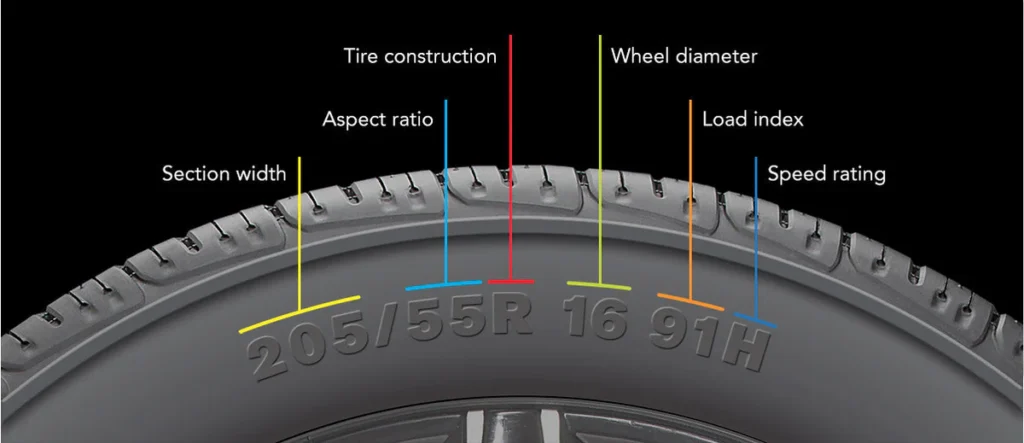
Every tire on your car has a code stamped right into the sidewall – something like 205/55R16 91H. It looks like a random string of numbers and letters, but it actually tells you everything about that tire’s width, height, construction, and how much weight and speed it’s rated to handle. Knowing how to read it means you can always order the exact right tire for your car, whether you’re replacing a worn set or upgrading before a road trip across Jordan.
Breaking Down a Tire Size Code
Take the example 205/55R16 91H. Each part of that code has a specific meaning:
- 205 – Section width in millimeters, measured from sidewall to sidewall.
- 55 – Aspect ratio, the tire’s height as a percentage of its width. Here, the sidewall height is 55% of 205mm.
- R – Construction type. R means radial, which is standard on nearly every passenger and SUV tire sold today.
- 16 – Rim diameter in inches. This tire fits a 16-inch wheel.
- 91 – Load index, the maximum weight the tire can carry when properly inflated.
- H – Speed rating, the maximum speed the tire is rated for under that load.
Load Index: How Much Weight Your Tire Can Carry
The load index is a number, not a direct weight, and it maps to a specific carrying capacity per tire. A few common values you’ll see on passenger cars and SUVs in Jordan:
- 75 = 387 kg
- 80 = 450 kg
- 85 = 515 kg
- 88 = 560 kg
- 91 = 615 kg
- 94 = 670 kg
- 95 = 690 kg
- 100 = 800 kg
- 104 = 900 kg
- 109 = 1,030 kg
Always match or exceed your vehicle manufacturer’s recommended load index – it’s listed on the sticker inside your driver’s door frame. Going lower can overload the tire; going higher is generally safe but adds unnecessary cost and weight.
Speed Rating: What the Letter Means
The speed rating letter shows the maximum speed a tire can sustain under its rated load. Common ratings include:
- Q = 160 km/h
- S = 180 km/h
- T = 190 km/h
- H = 210 km/h
- V = 240 km/h
- W = 270 km/h
- Y = 300 km/h
Most passenger cars in Jordan run on H or V-rated tires. Never fit a tire with a lower speed rating than your manufacturer recommends, even if you rarely drive at high speeds – the rating also reflects the tire’s overall heat tolerance and structural design.
Other Markings Worth Knowing
- DOT date code – A four-digit code (e.g. 2224) showing the week and year of manufacture. ‘2224’ means the 22nd week of 2024. Tires older than 6-10 years should be inspected or replaced regardless of tread depth.
- Max load and pressure – Printed near the size code, showing the tire’s absolute maximum load and inflation pressure, not the recommended everyday setting for your car.
- M+S or 3PMSF symbols – Mud and snow or the three-peak mountain snowflake symbol indicate a tire rated for winter or all-weather traction, relevant if you drive through areas like Jerash or the higher-altitude roads around Amman in winter.
- Directional or asymmetric markings – An arrow or “Rotation” label means the tire must be mounted in a specific direction; “Outside” labels mean one side must always face outward.
Why Getting the Right Size Matters
Fitting the wrong size or rating isn’t just a compliance issue. A tire with too low a load index can fail under normal driving weight. A narrower or shorter tire can throw off your speedometer, ABS, and stability control calibration. And a mismatched size can rub against the wheel well or affect ground clearance. Manufacturer-specified sizes exist for a reason – they’re tested against your exact vehicle’s weight, suspension geometry, and handling characteristics.
Finding Your Exact Size in Jordan
The fastest way to avoid guesswork is to use our Shop By Vehicle tool – enter your car’s make, model, and year, and we’ll show you the exact factory tire sizes for it, including staggered fitments where the front and rear sizes differ. You can also check our vehicle tire size guides for specific models.
FAQs
Can I fit a different tire size than what came on my car?
Within limits, yes – but any change should stay within about 3% of the original tire’s overall diameter to avoid affecting your speedometer and safety systems. When in doubt, stick with the manufacturer-specified size.
What happens if I use a lower load index than recommended?
The tire can be overloaded during normal driving, which increases heat buildup and the risk of a blowout, especially at higher speeds or with a full car.
Do I need winter tires in Jordan?
For most of the country, no – standard all-season passenger tires are fine. If you regularly drive mountain roads in winter, an M+S or 3PMSF-rated tire adds useful traction.
Where do I find my car’s recommended tire size?
Check the sticker inside the driver’s door frame, the fuel filler flap, or your owner’s manual – or just use our Shop By Vehicle tool and we’ll look it up for you.
